Strategy
Part of Do you need a talent manager as a YouTuber in the UK?
Do you need a talent manager as a YouTuber in the UK?
Work out whether a YouTube talent manager earns their commission: UK platform rules, HMRC self-employment status and what agents actually do for creators.
What to take away
- Most UK YouTubers do not need a talent manager until brand deals, licensing and live work take about a day a week to run.
- Commission is the main cost. On an illustrative £50,000 year of deal income, a 20 per cent fee is £10,000.
- You will usually stay self-employed, invoice the brand and file your own Self Assessment return.
- Agencies in Great Britain are regulated by the Employment Agencies Act 1973, which limits upfront charges.
- Paid promotions need clear labelling under the ASA's advertising codes, whoever negotiates them.
What a talent manager actually does for a YouTuber
A YouTube channel earns from AdSense, memberships, merchandise, brand integrations and licensing of older videos. Keeping those streams moving is administrative work that grows with each new deal.
A manager negotiates rates, chases late invoices, reads contracts and filters inbound pitches. They also push back on usage rights, exclusivity and payment terms you may not spot.
Knowing whether you are talking to a talent manager or an influencer marketing agency changes the deal, so read talent manager vs influencer marketing agency before your first meeting.
A manager is not a lawyer, an accountant or your editor. They handle the business of being paid, not the work itself.
When the numbers justify the fee
Start with hours, not subscribers. If deal admin, invoicing and negotiation eat fewer than four hours a month, an agent's commission rarely returns more than it costs.
Look at deal flow. One £2,000 integration a quarter will not fund representation. Eight deals a year might.
Then check concentration. If one brand pays most of your bills, you need negotiation more than lead generation.
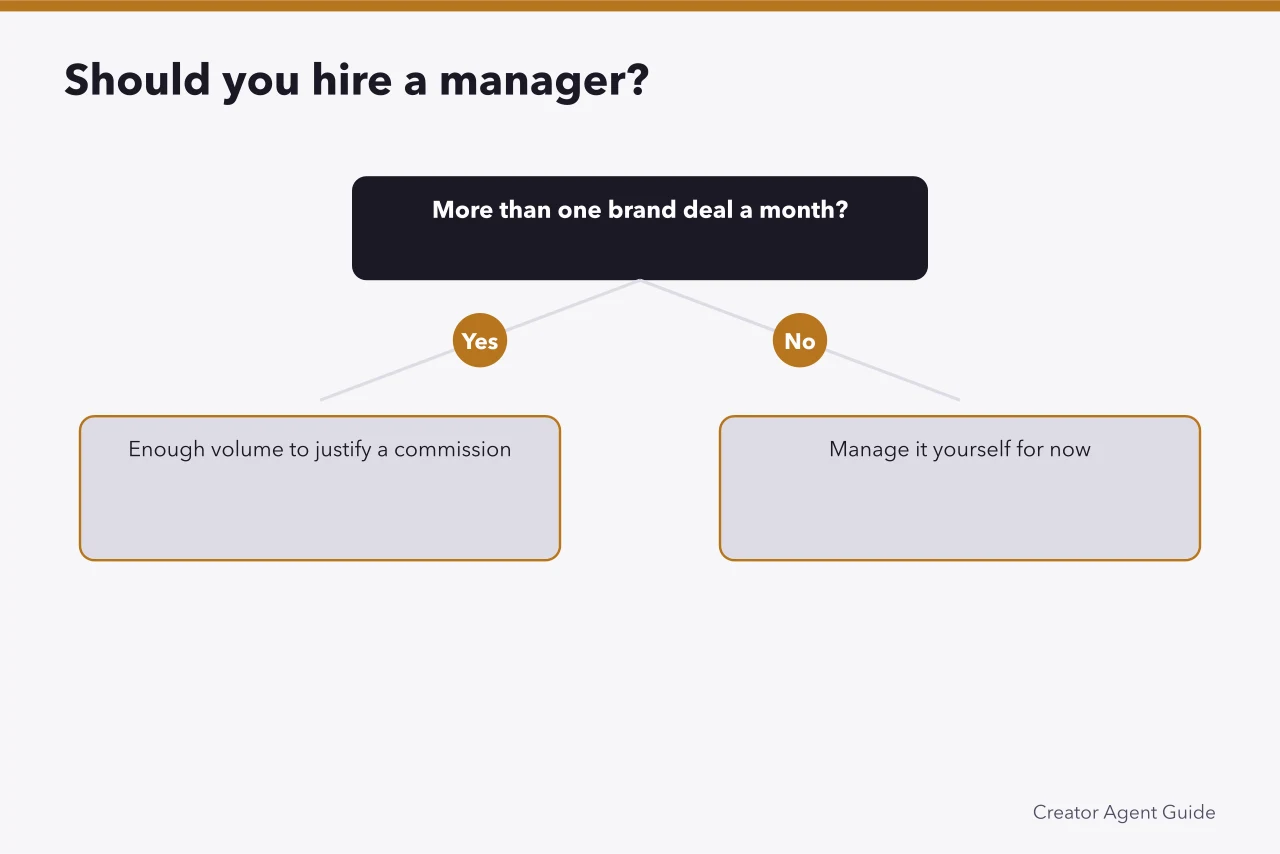
The table below sets out the signals that usually point towards hiring a manager.
| Signal | What it suggests |
|---|---|
| More than one brand deal a month | Enough volume to justify a commission |
| Pitches you cannot answer quickly | You need filtering and admin support |
| Income across four or more streams | Coordination is worth paying for |
| One deal a year, no licensing or live work | Manage it yourself for now |
| Contracts you sign unread | Get legal review before representation |
Subscriber count matters less than deal income. A small channel with a niche audience can attract more brand interest than a large one in a crowded category.
On an illustrative £40,000 of brand income, a 20 per cent commission is £8,000 a year. The fee only works if the agent adds more than that. That could come as better rates, extra deals or saved time.
Employment status, tax and the paperwork
Most UK creators work as sole traders. You register the business side with HMRC, invoice brands directly and file a Self Assessment return each year. The set up a business guidance on GOV.UK explains the registration steps.
Your agent charges commission on what you earn. That is a business expense, not employment income, and the arrangement does not make you an employee of the agency.
Some creators trade through a limited company once income is stable. That adds filing duties, and brands that treat you like staff can raise IR35 questions.
Agencies operating in Great Britain are covered by the Employment Agencies Act 1973, which restricts upfront fees and regulates how terms are presented to work-seekers.
Paid collaborations, including gifted products, fall under the CAP advertising codes enforced by the ASA. A manager should flag disclosure, not leave it to you.
A decision checklist before you sign
Work through these before committing to anything:
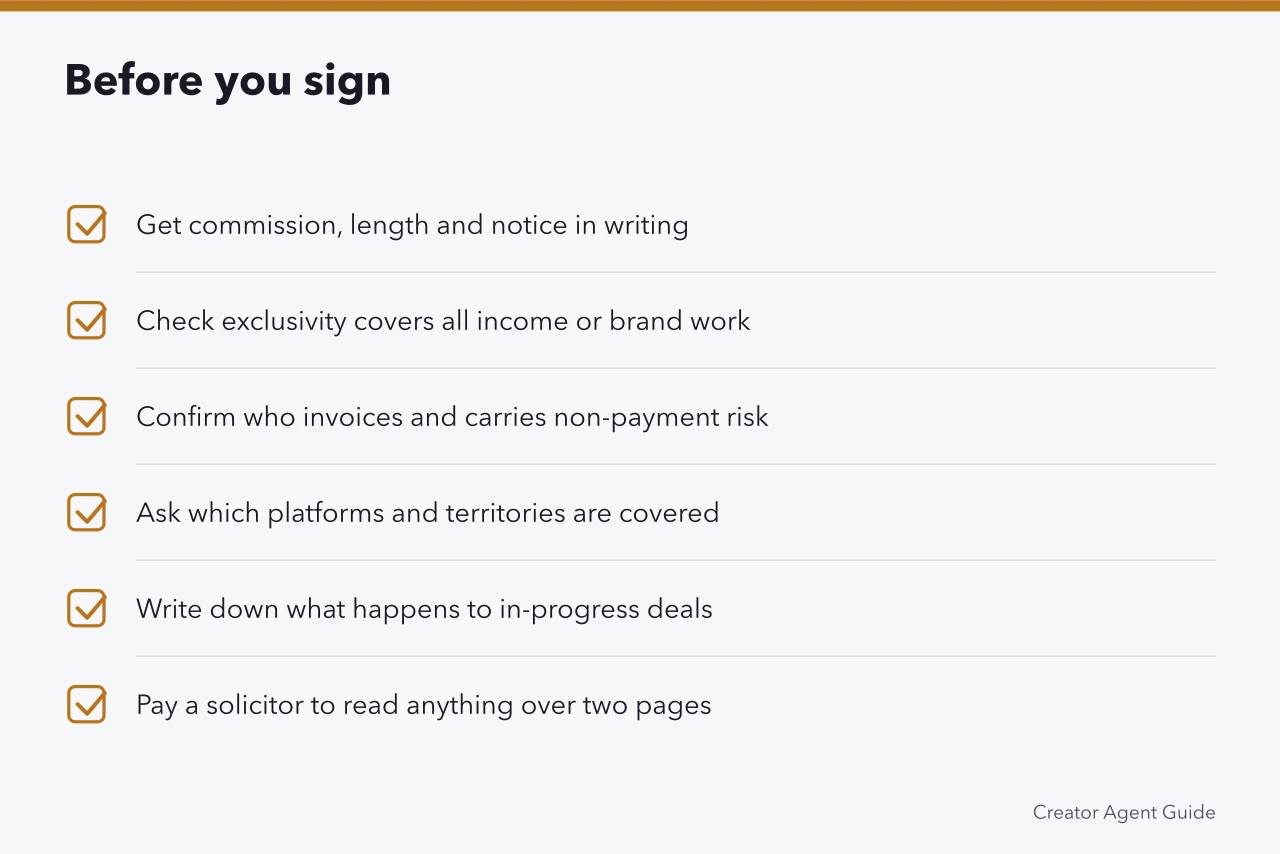
- Get the commission rate, contract length and notice period in writing.
- Check whether exclusivity covers all income or brand work only. Exclusivity clauses are where most disputes start, so read up on talent agency exclusivity clauses before you commit.
- Confirm who invoices the brand and who carries the risk if the brand does not pay.
- Ask which platforms and territories the agreement covers, including Shorts and podcasts.
- Write down what happens to deals already in progress when the contract ends.
- Pay a solicitor to read anything longer than two pages.
Common questions
Do I need a talent manager with 20,000 subscribers?
Not on subscriber count alone. The real question is how much admin your deals create each month. If four or five brands approach you every week, representation starts to make sense.
How much does a YouTube talent manager charge in the UK?
Commission models vary by agency and by the work involved. Ask for the rate on brand deals, ad revenue and merchandise separately, because some agreements treat each stream differently.
Can a manager take commission on my AdSense income?
Some do, and many do not. AdSense pays automatically with little negotiation involved, so paying a commission on it is hard to justify unless the agent handles wider channel strategy.
Is a talent manager worth it for a small channel?
Usually not until you have steady deal flow. A manager earns their fee by improving terms and finding work you would otherwise miss.