Rules and ethics
Part of Talent agency exclusivity clauses: what to know before signing
Talent agency exclusivity clauses: what to know before signing
Exclusivity clauses in UK talent agency contracts: typical terms, CMA unfair terms guidance, notice periods and what creators should check before signing.
What to take away
- Exclusivity makes one agency your only route to paid work in a stated category, territory and period. It is not the same as handing over your brand deals outright.
- Length is negotiable. What matters is whether the term ends on a fixed date or rolls on automatically.
- Post-term restrictions are enforceable only so far as they protect a genuine agency interest. Wide, open-ended wording is the usual weak point.
- The CMA's unfair terms guidance is aimed at consumer contracts, so do not assume it will rescue a business-to-business creator deal. Read every word before signing.
What an exclusivity clause actually does
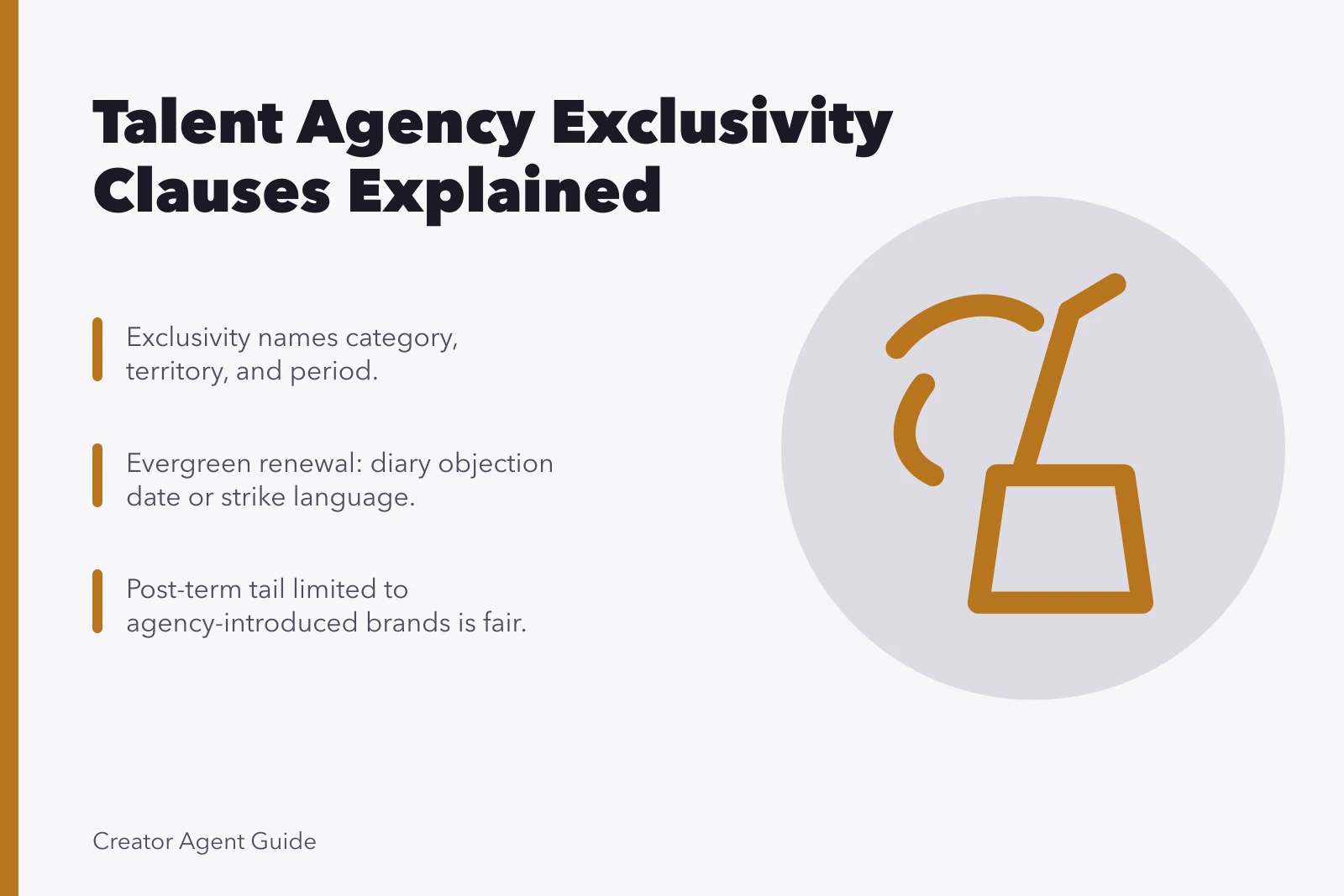
An exclusivity clause stops you signing with a competing agency or taking similar work directly. It normally names a category, a territory and a period, and it sits alongside the commission rate.
Scope is where disputes begin. 'Any commercial opportunity' is far wider than 'brand partnerships in the gaming category', so ask for the category to be described in plain words and tested against real examples.
Exclusive representation is the older entertainment model, described in general terms in the entry on talent agents. The agent finds the work and takes a share, so exclusivity protects their pipeline. If your deal is commission-only, the rate matters as much as the clause, and what influencer management agencies charge in the UK sets out how those percentages are built.
Typical exclusivity periods and how they are worded
There is no standard length, but the fixed term is the anchor. A clause that runs for the initial term and then renews only by written agreement gives both sides a review point.
Evergreen wording is the one to watch. If the contract renews unless you object, diary the objection date or strike the renewal language.
Post-term tails deserve their own line in the contract. A tail limited to brands the agency introduced is a fair trade. A tail covering everything in the sector is a restraint you may be able to resist.
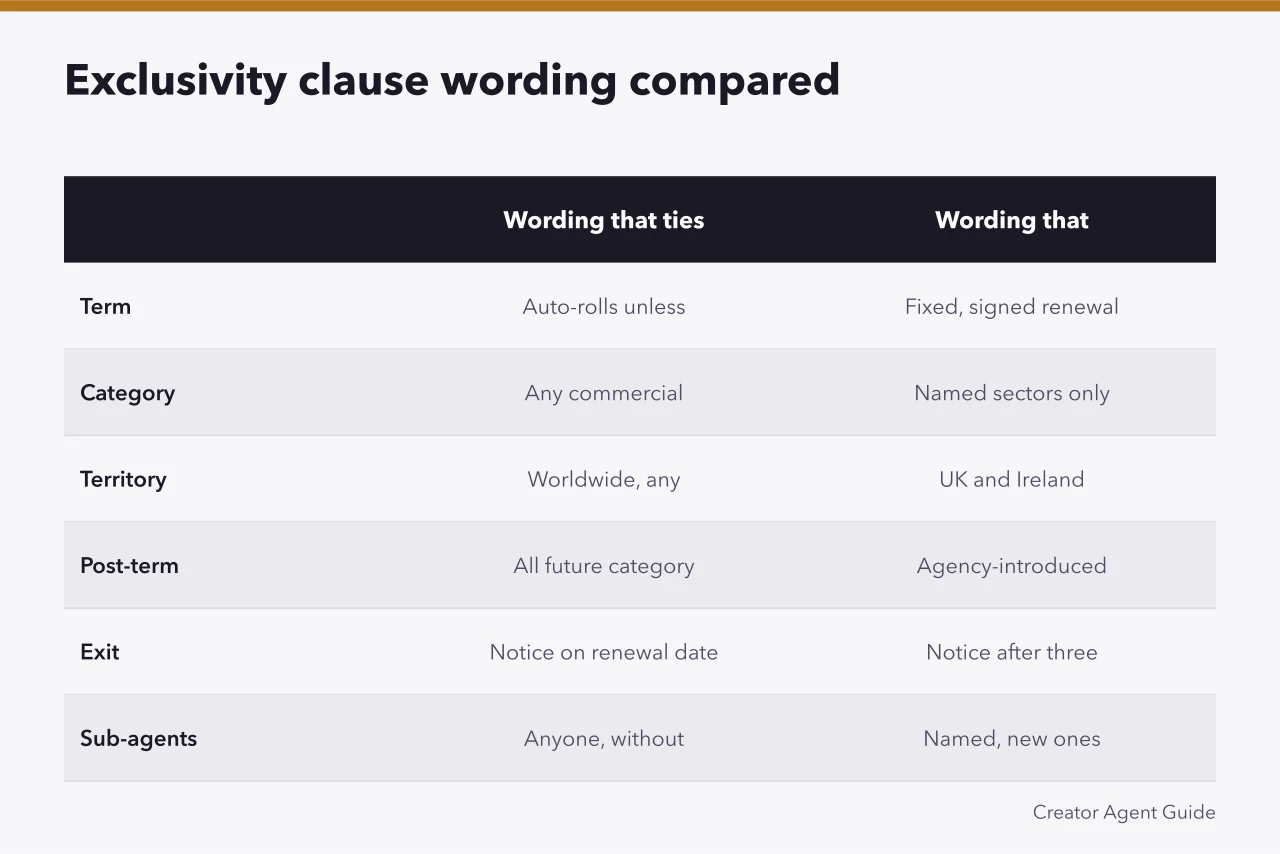
| Clause feature | Wording that ties your hands | Wording that leaves room |
|---|---|---|
| Term | Rolls over automatically unless you object in writing | Fixed period, renewed only by signed agreement |
| Category | Any commercial opportunity connected to your content | Named sectors, such as beauty, gaming or family travel |
| Territory | Worldwide, in any language | UK and Republic of Ireland, widened by agreement |
| Post-term | Commission on all future work in the category | Commission only on agency-introduced deals, for a stated period |
| Exit | Notice accepted only on the renewal date | Written notice at any time after the first three months |
| Sub-agents | Agency may appoint anyone without telling you | Named sub-agents, with your approval for new ones |
Where UK contract law draws the line
No statute caps how long exclusivity can run in a commercial agency agreement. The clause lives or dies on ordinary contract law, plus restraint of trade cases that ask whether a restriction goes further than a legitimate interest requires.
Read who can enforce the deal. Wording that gives a brand direct rights over your contract can be effective under the Contracts (Rights of Third Parties) Act 1999, which is rarely what a creator intends.
Agencies that place people into work are regulated by the Employment Agencies Act 1973. Most creator representation is a contract for services, so the Act rarely decides an exclusivity argument. It can still matter where the agency places you into specific engagements on a regular basis.
The CMA's unfair terms guidance covers consumer contracts and flags terms that let one side change the deal. If you sign as a business, that regime does not protect you, so the wording is yours to negotiate.
Clause-by-clause checks before you sign
- Write the category in plain words, with examples of what is in and what is out.
- Set the territory to where you actually work, and widen it only in writing.
- Fix an end date and delete automatic renewal, or make renewal an explicit opt-in.
- Tie any post-term commission to brands the agency introduced, for a stated period.
- Ask what happens to approaches you turn down, and whether they stay exclusive for a set time.
- Agree the exit: notice period, commission tail and how unpaid invoices are handled.
- Before signing, work through the questions to ask a UK talent agency before signing and get anything that matters written into the contract.
Common questions
Is exclusivity in a UK talent agency contract legally enforceable?
Usually yes, because it is a term of a contract you signed freely. A court can decline to enforce a restraint that is wider than needed to protect the agency's legitimate interest.
How long should an exclusivity period run?
There is no legal maximum, so use the initial term as your limit. Aim for a fixed period with renewal by written agreement rather than an open-ended rollover.
Can I work with two agencies at once?
A single exclusivity clause normally blocks that in the same category. You can split by category or territory if both contracts define their scope clearly enough not to overlap.
What happens if I breach an exclusivity clause?
The agency may claim the commission it says it lost, or apply for an injunction to stop you working with the other party. The claim is limited by how reasonable the clause is.