Costs and pricing
Part of What Do Influencer Management Agencies Charge in the UK?
What Do Influencer Management Agencies Charge in the UK?
Typical influencer management agency fees in the UK, from commission percentages and retainers to VAT treatment and the contract terms that decide what you pay.
What to take away
- Commission on brand fees is the default model, taken as a percentage of the gross deal value.
- Ask an agency for a worked example on a real deal rather than a headline rate.
- VAT at 20% applies to the commission when the agency is VAT-registered, and an unregistered creator cannot reclaim it.
- Exclusivity and commission tails usually shape the final bill more than the percentage does.
The fee models agencies use
A commission-only deal is the most common arrangement. The agency takes a slice of every deal it sources or negotiates, and earns nothing when the creator earns nothing.
The monthly retainer flips that. For a fixed sum, the agency handles outreach, rate cards, contracts and admin, whether or not deals land that month.
Hybrid deals sit between the two: a smaller retainer plus a reduced commission. That suits creators with steady brand work and a few larger campaigns.
Before comparing quotes, know the difference between a talent manager and an influencer marketing agency, because the two charge on different events.
Illustrative commission and retainer ranges
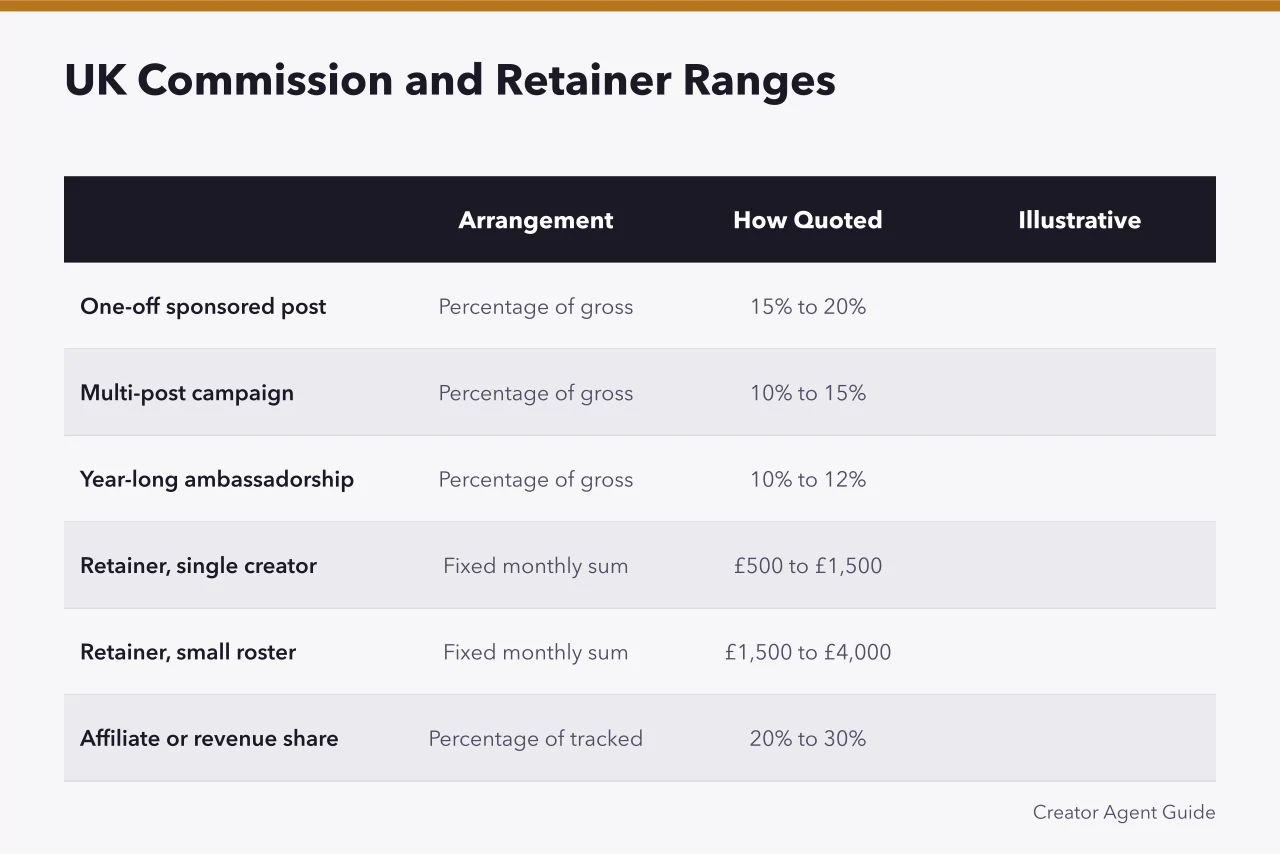
The table below shows how quotes are commonly structured in the UK. The figures are illustrative examples of market practice, not survey data.
| Arrangement | How it is quoted | Illustrative figure |
|---|---|---|
| One-off sponsored post | Percentage of the gross fee | 15% to 20% |
| Multi-post campaign | Percentage of the gross fee | 10% to 15% |
| Year-long ambassadorship | Percentage of the gross fee | 10% to 12% |
| Retainer, single creator | Fixed monthly sum | £500 to £1,500 |
| Retainer, small roster | Fixed monthly sum | £1,500 to £4,000 |
| Affiliate or revenue share | Percentage of tracked revenue | 20% to 30% |
Platform ad revenue is often treated separately. YouTube ad income is frequently excluded from commission because it arrives without a negotiation or an invoice.
A worked example on a £4,000 campaign
Here is how the arithmetic looks on a single brand deal. All figures are illustrative.
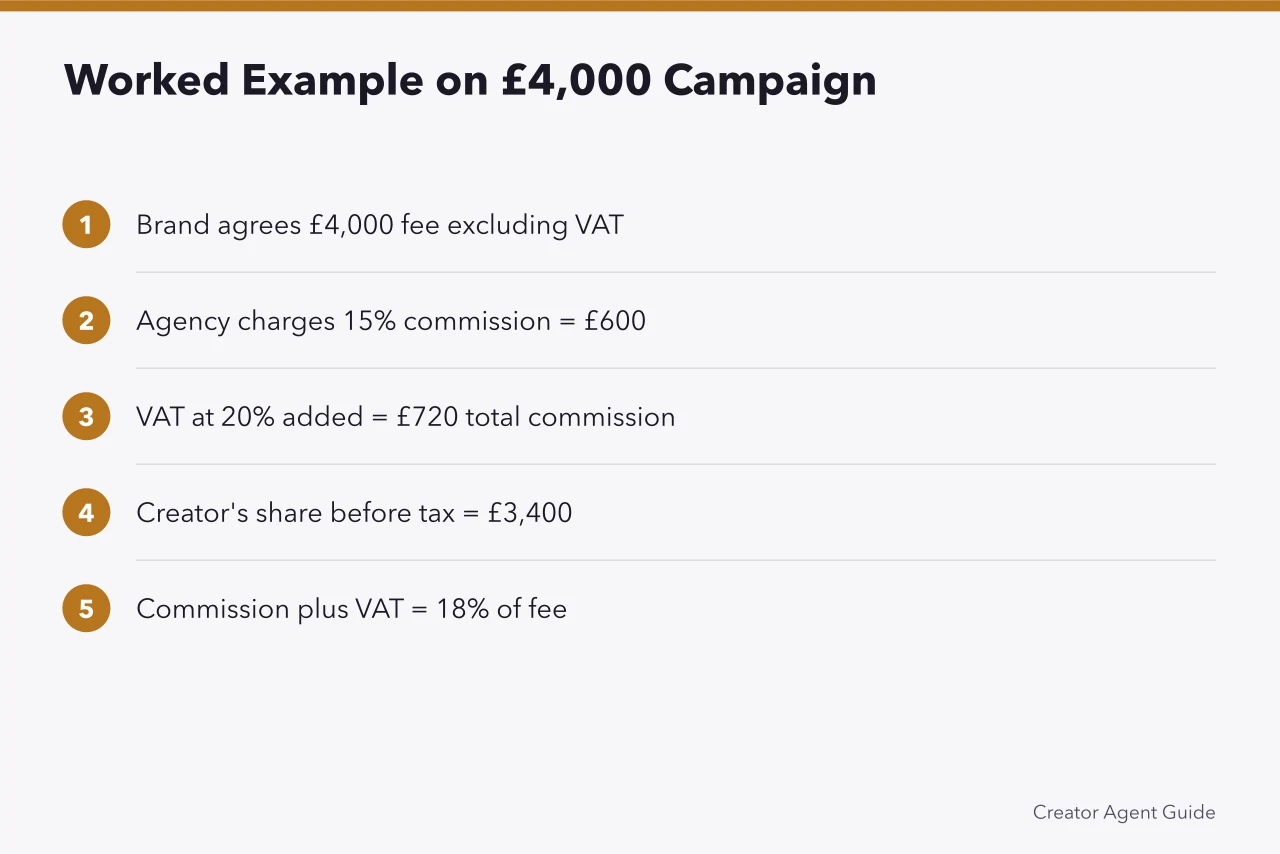
- The brand agrees a fee of £4,000 excluding VAT for a three-post campaign.
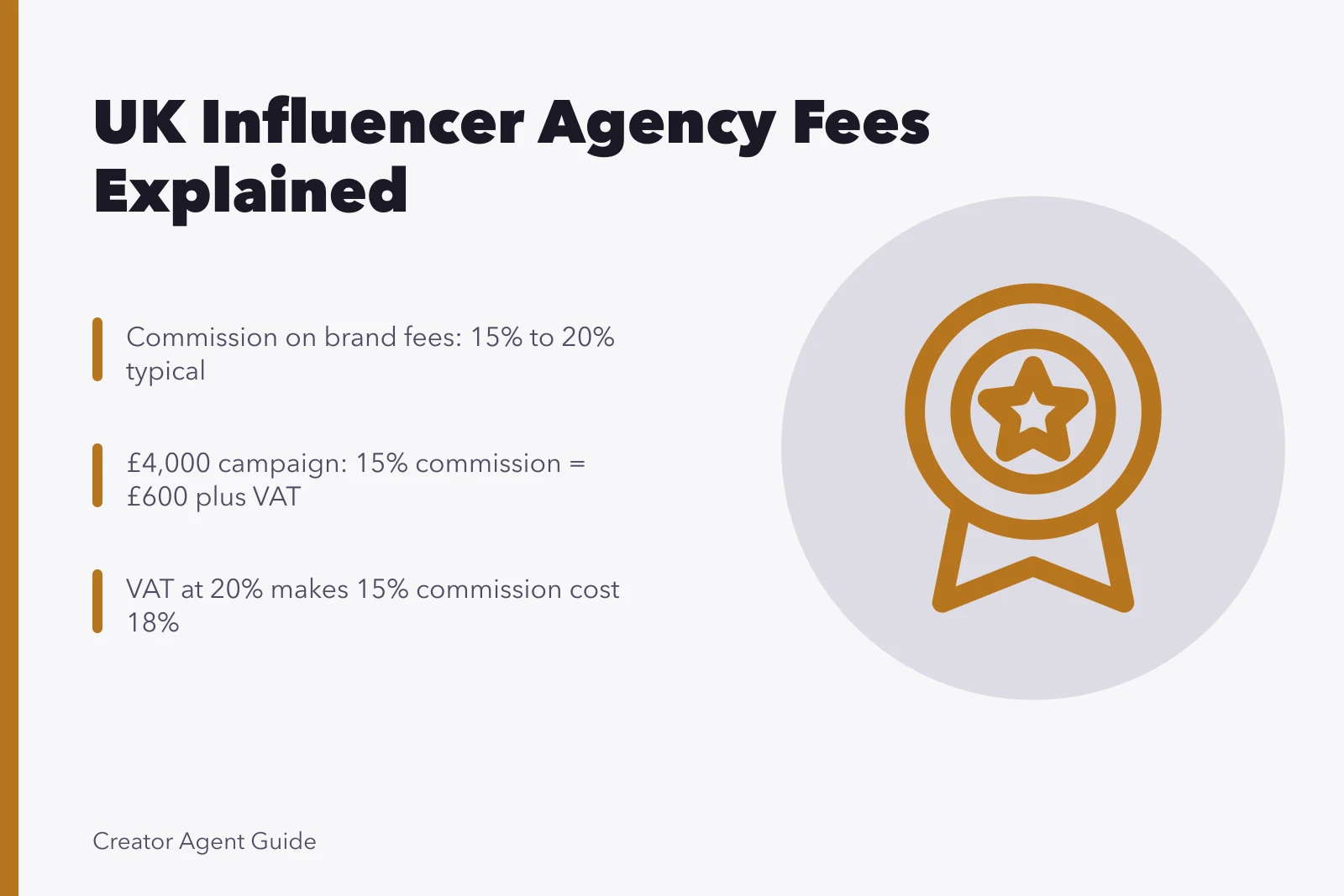
- The agency charges 15% commission on the gross fee, which comes to £600.
- VAT at 20% is added to the commission, bringing the total cost of the commission to £720.
- The creator's share of the fee, before their own tax position, is £3,400.
- Commission plus irrecoverable VAT equals 18% of the £4,000 fee.
How VAT lands on the commission
Commission is a supply of services, so VAT applies at the standard rate of 20% whenever the agency is VAT-registered.
If the creator is not registered, that VAT is a real cost. It cannot be reclaimed, so a 15% commission behaves like an 18% charge.
Brands normally agree fees plus VAT. Ask who invoices the brand, because that decides whose turnover the fee sits in.
Contract terms that decide the final bill
Exclusivity is the first thing to price. If the agency is the only route to brand work, a direct approach may breach the deal.
Commission tails are the second. A tail keeps the agency's entitlement running after the contract ends, on deals it introduced during the term.
Brands sometimes want to enforce terms against a creator they never signed with. In England and Wales, the Contracts (Rights of Third Parties) Act 1999 governs when a third party can enforce a term.
Scots law treats third-party rights differently, so check which jurisdiction the contract names.
Agencies that also place people into paid work sit under the Employment Agencies Act 1973.
What the commission covers
Negotiation is only part of it. The fee usually covers rate benchmarking, contract review, invoicing and chasing late payment.
Compliance sits inside the fee too. The CAP Code requires ads to be obviously identifiable as advertising, and agencies often draft the disclosure wording.
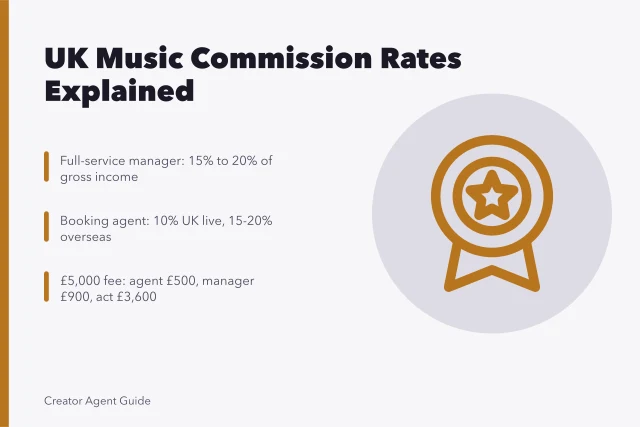
Reading across sectors helps when judging a quote. music talent agency commission rates show how much of a cut is normal when an agency books the work itself.
Common questions
Does the agency take commission before or after VAT?
Commission is calculated on the fee excluding VAT. VAT is then added to the commission, not to the creator's share, so the two numbers move separately.
Is a retainer or a commission cheaper?
It depends on deal flow. A retainer costs the same in a quiet month, while commission costs nothing when no work lands.
What is a commission tail?
A clause that keeps the agency's commission running after the contract ends, on deals it introduced during the term. Agree the period and the brands it covers before signing.
Can a brand and creator deal directly to avoid the fee?
Usually yes, unless an exclusivity clause stops it. Brands often prefer it because it removes a layer of commission, though they lose the agency's contracting work.