
Foundations
Part of Talent manager vs influencer marketing agency: what's the difference?
Talent manager vs influencer marketing agency: what's the difference?
A talent manager works for the creator and an influencer marketing agency works for the brand. How UK commission, contracting and brand deals divide up.
What to take away
- A talent manager represents the creator, paid by retainer or commission, and looks after the whole career.
- An influencer marketing agency represents the brand, charging a campaign fee or a share of the media budget.
- Managers negotiate contracts and long-term deals, while agencies cast, brief and report on campaigns.
- A single company can do both, but the paying side usually wins when interests collide.
Start with who holds the contract
The quickest test is who signs the paperwork. A manager contracts with the creator, so the relationship is one of representation. An agency contracts with the brand, so the relationship is one of supply.
That single fact drives the advice you get and who hears about a problem first.
Talent management: representing the creator
A manager handles creator representation across a whole career, not one campaign. That covers rate cards, platform strategy, long-term deals and the awkward conversations about money.
Commission is normally a percentage of what the creator earns, and retainers are common for newer creators who cannot fund a percentage yet. The percentage is rarely the whole story, so compare what each side actually does.
Ask what the percentage applies to. Gross fees and net income give very different answers.
How influencer agencies are paid instead
Influencer marketing agencies sit on the brand side. They are usually paid a campaign fee, a retainer from the brand, or a share of the media budget spent on creator content.
The agency roles are narrower, covering casting, briefing, contracts and reporting. A good agency will also handle usage rights and whitelisting paperwork that creators rarely want to negotiate alone.
If the split still feels unclear, which side handles brand campaigns explains how UK agencies take on campaign work that managers often decline.
Commission, contracting and disclosure side by side
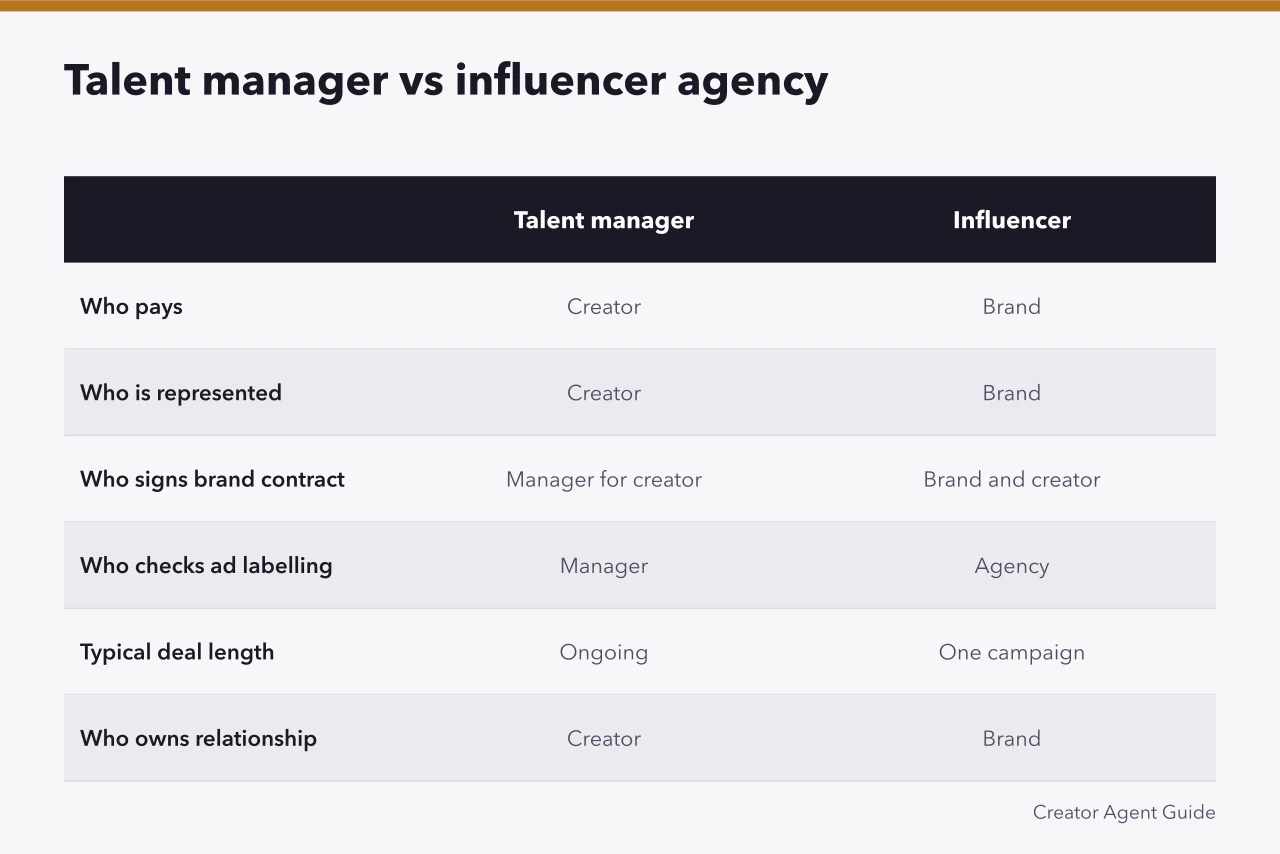
The table below compares the two models on the points that cause most disputes.
| Question | Talent manager | Influencer marketing agency |
|---|---|---|
| Who pays | The creator, by retainer or commission | The brand, by campaign fee or budget share |
| Who is represented | The creator | The brand |
| Who signs the brand contract | Often the manager, acting for the creator | The brand and creator sign, with the agency named |
| Who checks ad labelling | The manager, before a post goes live | The agency, inside its approval process |
| Typical deal length | Ongoing, with notice periods | One campaign or one budget year |
| Who owns the relationship | The creator, subject to the contract | The brand, for the campaign period |
Disclosure rules do not move
Ad labelling follows the content, not the contract. If money or free product has changed hands, the post needs a label a viewer sees without clicking.
The advertising codes published by the ASA and CAP apply whoever posts the content. Managers should check drafts before they go live, and agencies should build that check into the approval chain.
How a brand deal moves through both sides
- The brand approaches the manager with a budget and a brief.
- The manager checks the fit, agrees a fee and confirms the deliverables in writing.
- If an agency is involved, it casts extra creators from its roster.
- Contracts name usage rights, territory and the length of the licence.
- Both sides check the ad label before the post goes live.
Where the two overlap
Both sides chase the same brand budgets, so the practical difference is who holds the relationship. A manager may pitch a creator to a brand, while an agency may ask a manager for access to that creator's audience. Most UK campaigns involve both, and the invoice tells you which one you hired.
What the contracts usually say
Management agreements tend to roll on, with a notice period and a tail clause that survives the contract itself.
Agency contracts are shorter and tied to a campaign or a budget year. Read the cancellation terms, because a brand can pull spend after the brief has been accepted.
Whoever drafts the document, the creator should keep the right to approve any post that carries their name. Working through the questions to ask a UK talent agency before you sign is cheaper than renegotiating later.
Common questions
Is a talent manager the same as an agent?
An agent sources and negotiates individual engagements, while a manager covers the wider career, as the Wikipedia entry on talent agents sets out. The Employment Agencies Act 1973 governs agencies in Great Britain that find work for people. That is the right starting point if you want to check how a company is regulated.
Which should a brand hire?
An influencer marketing agency, in most cases. Brands buy campaigns rather than careers, and an agency brings casting, contracting and reporting in one place. Hire a manager when you want a long-term ambassador already represented by one.
Can one company be both?
Yes, some talent management companies also run campaign teams for brands. Ask who is paying for the service on each side of the deal and get the conflict policy in writing.
Who pays the manager when a brand deal comes through an agency?
The creator does, unless the contract says otherwise. Check whether the agency fee is deducted before or after the manager's commission, because the order changes what lands in your account.


