Tools and providers
Part of Influencer agency or talent agency: which handles brand campaigns?
Influencer agency or talent agency: which handles brand campaigns?
How UK brands split campaign work between an influencer agency and a talent agency, covering contracts, commission, disclosure and who pays whom.
What to take away
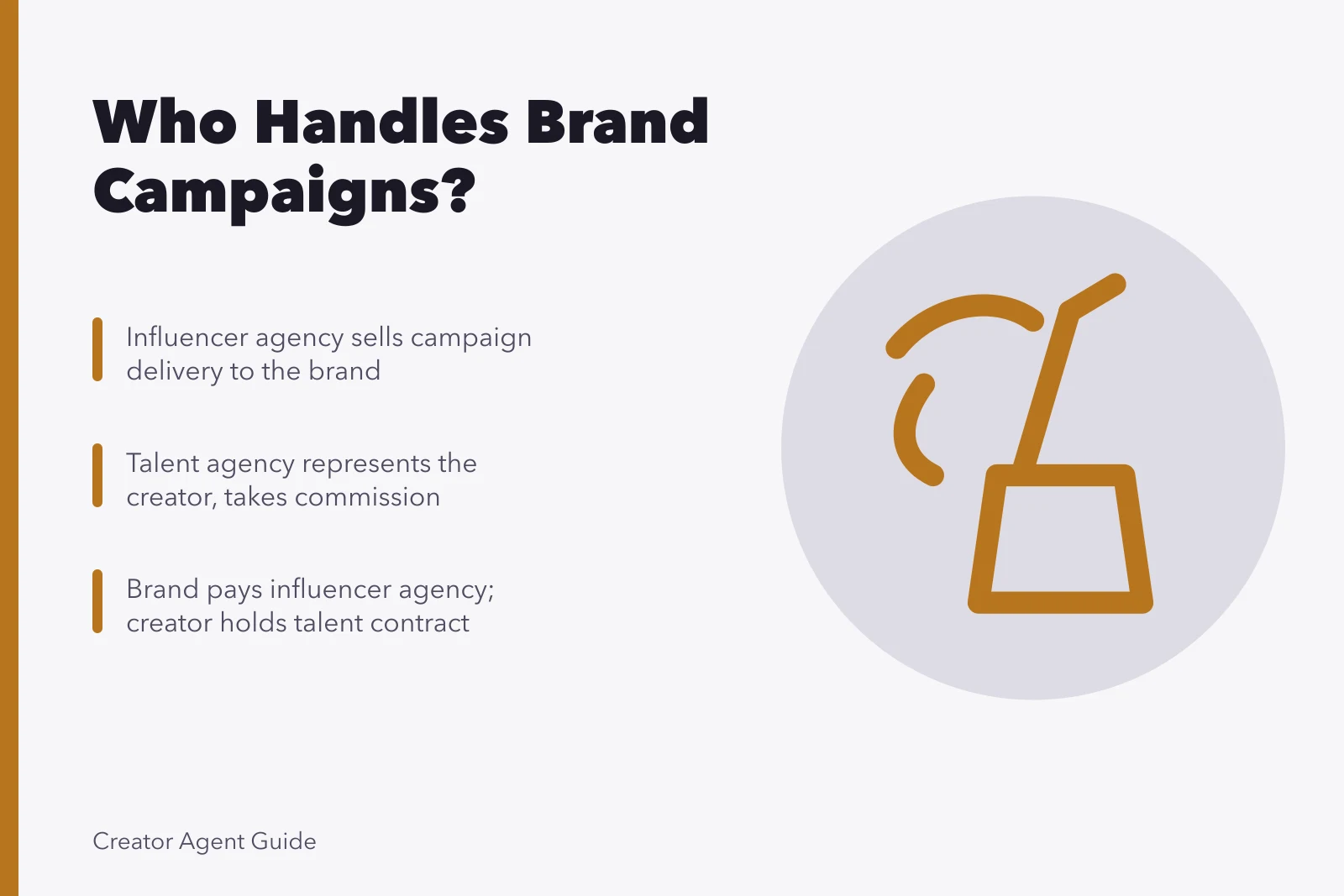
- An influencer agency sells campaign delivery to the brand: casting, briefing, usage rights and reporting sit on its side of the deal.
- A talent agency represents the creator, negotiating fees, exclusivity and long-term deals on that person's behalf.
- UK firms that do both exist, so the contract tells you who owes what, not the job title on the door.
- Brands normally hold the contract with the influencer agency; the creator holds theirs with the talent agency.
- Budget splits into campaign fees the brand pays and commission deducted from what the creator earns.
Two contracts, two jobs
A brand buying reach wants a campaign delivered against a brief. An influencer agency quotes for that work, then subcontracts creators to make it. The agency carries delivery risk and reports on performance.
A creator building a career wants representation. A talent agency signs that creator, takes a commission and negotiates on their behalf. The brand is not its client.
The confusion is understandable. The same creator may sit in both conversations, and some UK agencies run a management arm beside a campaign arm. If the labels blur, read the difference between a talent manager and an influencer marketing agency before you brief either.
How an influencer agency builds a brand campaign
Campaign work runs to a predictable sequence.
- Brief and budget. The brand sets the objective, the timetable and a fixed sum in pounds.
- Casting. The agency proposes creators whose audiences match the brief, not just the largest followings.
- Contracting. The agency contracts each creator, buys usage rights and agrees how disclosure will appear.
- Production and approval. Drafts are checked against the brand's claims and signed off before posting.
- Reporting. Reach, engagement and cost per result arrive after the campaign ends.
How a talent agency represents talent
A talent agency works for the creator. It negotiates rates, declines poor brand fits, manages exclusivity windows and chases late payment.
Agencies in Great Britain that introduce workers to engagements fall under the Employment Agencies Act 1973, which sets conduct rules on fees and terms. That is a different framework from the advertising rules a campaign must satisfy.
Day-to-day work also covers filming dates, travel, schedule clashes and longer-term positioning. None of it appears on a brand's campaign invoice.
Where the money sits
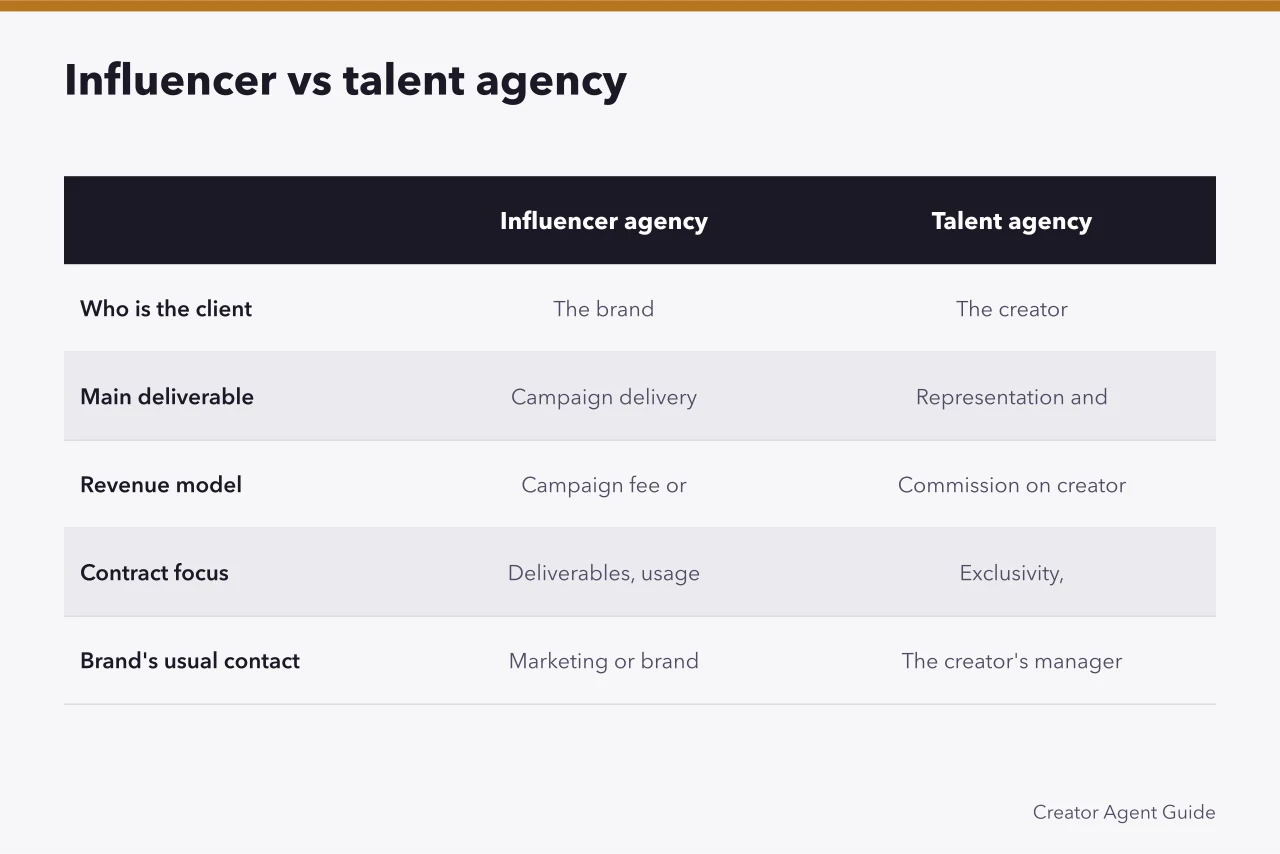
| Question | Influencer agency | Talent agency |
|---|---|---|
| Who is the client | The brand | The creator |
| Main deliverable | Campaign delivery | Representation and negotiation |
| Revenue model | Campaign fee or retainer | Commission on creator earnings |
| Contract focus | Deliverables, usage rights, reporting | Exclusivity, commission, term |
| Brand's usual contact | Marketing or brand team | The creator's manager |
Two invoices usually exist. The brand pays the influencer agency a campaign fee or retainer. The creator pays their talent agency commission out of what they earn, often a percentage of gross fees.
Ask which side your money lands on. A brand paying a creator directly still has to agree deliverables, the usage window and who owns the footage.
A retainer spreads cost across a quarter, which suits always-on programmes. One-off campaigns are usually quoted per deliverable.
Disclosure, data and children
The advertising codes enforced by the ASA apply to ads a brand pays for, including paid creator posts, so any paid partnership label must be clear before a viewer engages. Decide in the contract who checks it.
Both sides also process personal data. The ICO's guidance for organisations sets out what a lawful basis looks like before you collect creator or audience data for targeting.
If a campaign features a young creator, child employment and performance rules apply. The agency should confirm who holds the licence and who chaperones on the day.
Choosing the right partner
Need a campaign delivered by a date, with reporting attached? Brief an influencer agency. Need one creator tied into a six-month exclusivity deal? Speak to their talent agency.
Creators should look harder at conflicts of interest. An agency that also sells campaigns to brands may accept a lower rate to win the brand's wider business.
Compare the commission a talent agency quotes with what influencer management agencies charge in the UK, because the two figures are rarely calculated on the same base. See what influencer management agencies charge in the UK before you set a rate card.
Common questions
Can one company be both an influencer agency and a talent agency?
Yes, and several UK firms are. Keep the two contracts separate so fees, duties and liability stay clear.
Who pays the talent agency commission?
The creator does, normally as a percentage of gross earnings. Brands rarely see that figure.
Does a brand contract with the creator or with the agency?
Usually with the agency for campaigns, unless the talent agency negotiates directly for its client. Read the signature block before assuming.
What should be agreed before a campaign starts?
Deliverables, posting dates, usage rights, exclusivity, disclosure wording and payment terms. Put all six in writing.