Rules and ethics
Part of How to become a talent agent in the UK: career path
How to become a talent agent in the UK: career path
Talent agent careers in the UK: training routes, employment agency rules, trade body membership, commission and how to set up your own agency.
What to take away
- There is no single talent agency licence in the UK. The rules come from the Employment Agencies Act 1973 and the conduct regulations under it.
- Most agents learn the job inside an existing agency or management company before going independent.
- Trade bodies such as the Entertainment Agents' Association (UK) and agreements negotiated by Equity set the standards established agents work to.
- Under-18 clients add child employment rules and performance licensing duties.
- A sole trader structure is enough to start, though most agents incorporate once they hold client money.
The work: what a talent agent does
A talent agent finds paid work for clients and negotiates the terms. That means pitching to casting directors, producers, brands and promoters, then agreeing fees, usage rights and schedules. Behind that sits admin: invoicing, chasing late payment and tracking option dates.
Agents and managers are not the same job. An agent secures engagements and haggles over deals, while a manager guides the longer direction of a career. Understanding the difference between a talent manager and an influencer marketing agency helps you decide which service to sell.
Routes into talent representation
Few agents arrive through a graduate scheme. The usual entry point is an assistant or bookings role at an agency, a management company, a venue or a broadcaster.
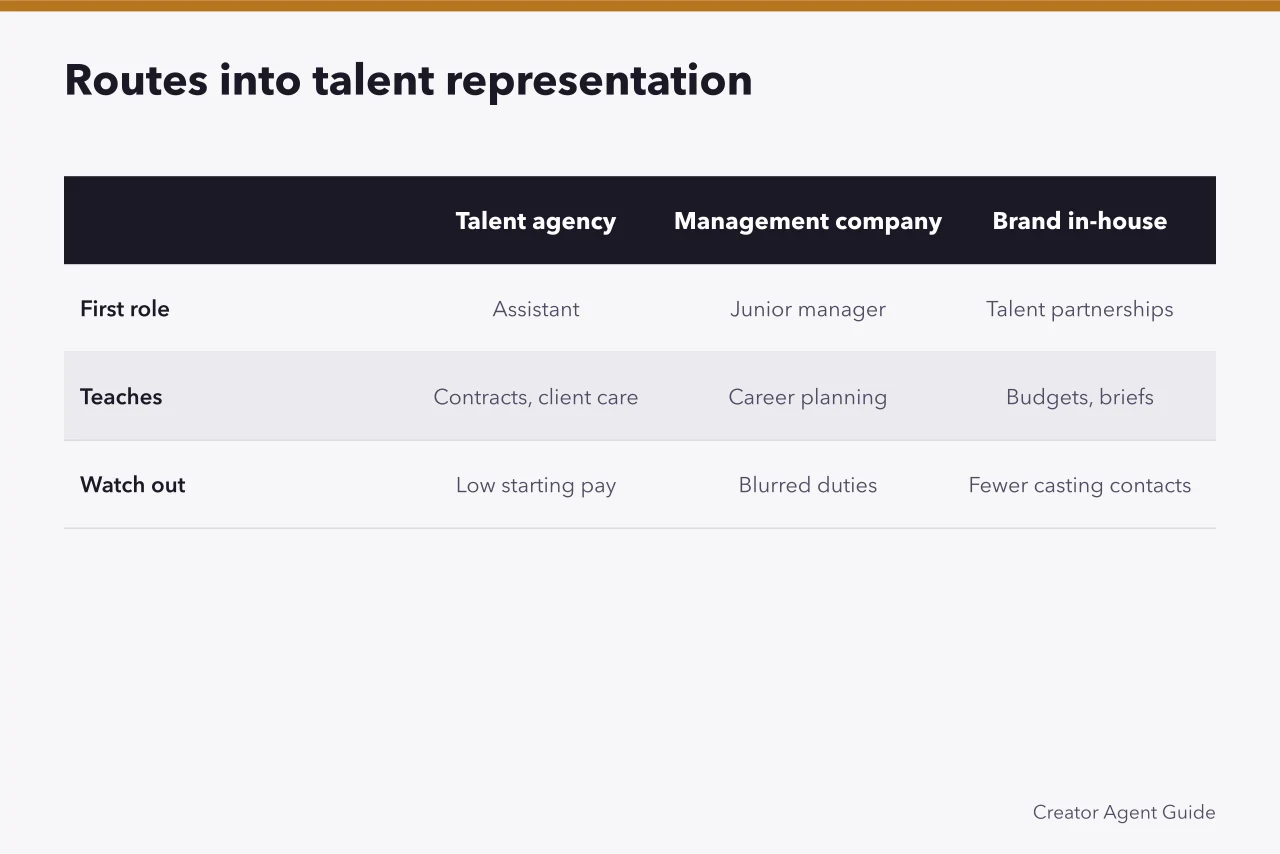
| Route | Typical first role | What it teaches | Watch out for |
|---|---|---|---|
| Talent agency | Assistant or bookings coordinator | Contract basics, client care, schedules | Low starting pay |
| Management company | Junior manager | Long-term career planning | Blurred agent and manager duties |
| Brand or in-house team | Talent partnerships executive | Budgets, briefs, brand expectations | Fewer casting contacts |
| Venue or promoter | Booking assistant | Negotiation, fees, touring logistics | Seasonal work and late nights |
Keep a written note of every deal you worked on, the fee agreed and the type of client. That record is the evidence a trade body or a prospective partner will ask for.
Do you need a licence to run a talent agency?
No. The statutory licensing scheme that once covered employment agencies has gone, and the sector now runs on a conduct regime instead.
The Employment Agencies Act 1973 is the foundation, with the Conduct of Employment Agencies and Employment Businesses Regulations 2003 sitting under it. The Employment Agency Standards Inspectorate can investigate complaints about how an agency treats work-seekers.
Employment agency law is not devolved, so the same framework applies across the UK.
For a new agency that means clear written terms, accurate records and no surprises on fees. Say in writing how you take commission before an engagement starts.
Working with under-18s
Children's representation is where new agents slip up most. Minimum ages and permitted hours are set out in child employment guidance on GOV.UK, and performance licences are issued by local authorities.
In practice you need a chaperone, a signed parental contract and a clear rule on holding a child's earnings, which some agencies keep in trust until the client turns 18.
Setting up: a step by step sequence
- Pick a niche. Actors, musicians, presenters, children's performers and online creators have different buyers.
- Work inside an agency first. Two years of booking and negotiating teaches more than a course.
- Register the business. Sole trader status is fine to start, and GOV.UK's set up a business guidance covers registration, tax and choosing a name.
- Arrange insurance and data handling. Professional indemnity cover, a written privacy notice and a secure place for client details.
- Write standard terms. Commission rate, contract length, notice period and what happens to live negotiations when a client leaves.
- Add clients slowly. One strong buyer relationship beats a long roster you cannot place.
Trade bodies and pay
The Entertainment Agents' Association (UK) is a long-standing trade body for entertainment agents. Membership is voluntary rather than a licence, but it shows a new agency follows agreed practice.
Income is commission-led rather than salaried, so earnings track the roster. Fee models vary across the sector, and what UK influencer management agencies charge is a useful benchmark when you set your own percentage.
For theatre, television and live work, Equity negotiates agreements that set minimum terms, so an agent booking those jobs needs to know them.
Common questions
Do I need a qualification to become a talent agent?
No. Employers look for evidence of deal-making and sector knowledge, so experience inside an agency counts for more than a certificate.
How do talent agents get paid?
Most charge commission on what a client earns, taken when the fee is paid in. Some charge a retainer instead, which suits creators with steady brand income.
Is a talent agency the same as an influencer marketing agency?
No. A talent agency represents the creator, while an influencer marketing agency usually works for the brand buying the campaign.
Can I run a talent agency from home?
Yes. Registration is straightforward and many agents start as sole traders. Insurance and data handling matter more than premises at that stage.