Rules and ethics
Part of How to find a children's talent agent in England: a parent's guide
How to find a children's talent agent in England: a parent's guide
How to find a children's talent agent in England: check Spotlight, Equity and local council performance licences before you sign with an agency.
What to take away
- A children's talent agent finds auditions, submits your child and negotiates the fee. It does not issue the licence.
- In England, the local council licenses paid performances under the Children and Young Persons Act 1963.
- Spotlight is the casting platform most UK productions search, so ask how your child's profile will be run.
- Treat a large upfront joining fee as a warning sign. Get commission, notice and exclusivity in writing.
What a children's talent agent does
A children's talent agent submits young performers for auditions and negotiates fee, usage and travel terms once a job is offered. They also chase the paperwork, from proof of age to school absence letters.
Casting work covers theatre, film, television and commercials. Branded content covers social campaigns, product launches and longer partnerships.
Some agencies specialise. A children's modelling agency handles stills and campaigns, while a drama agent works on scripted casting. Ask which list your child joins, and how often it is submitted.
Ask what the agency does not do. Some handle casting only and pass brand enquiries back to you, while others run the whole commercial side.
Spotlight, Equity and the England basics
Spotlight is the casting directory that UK casting directors search, and representation usually means a profile there. Children can be listed, normally through an agent.
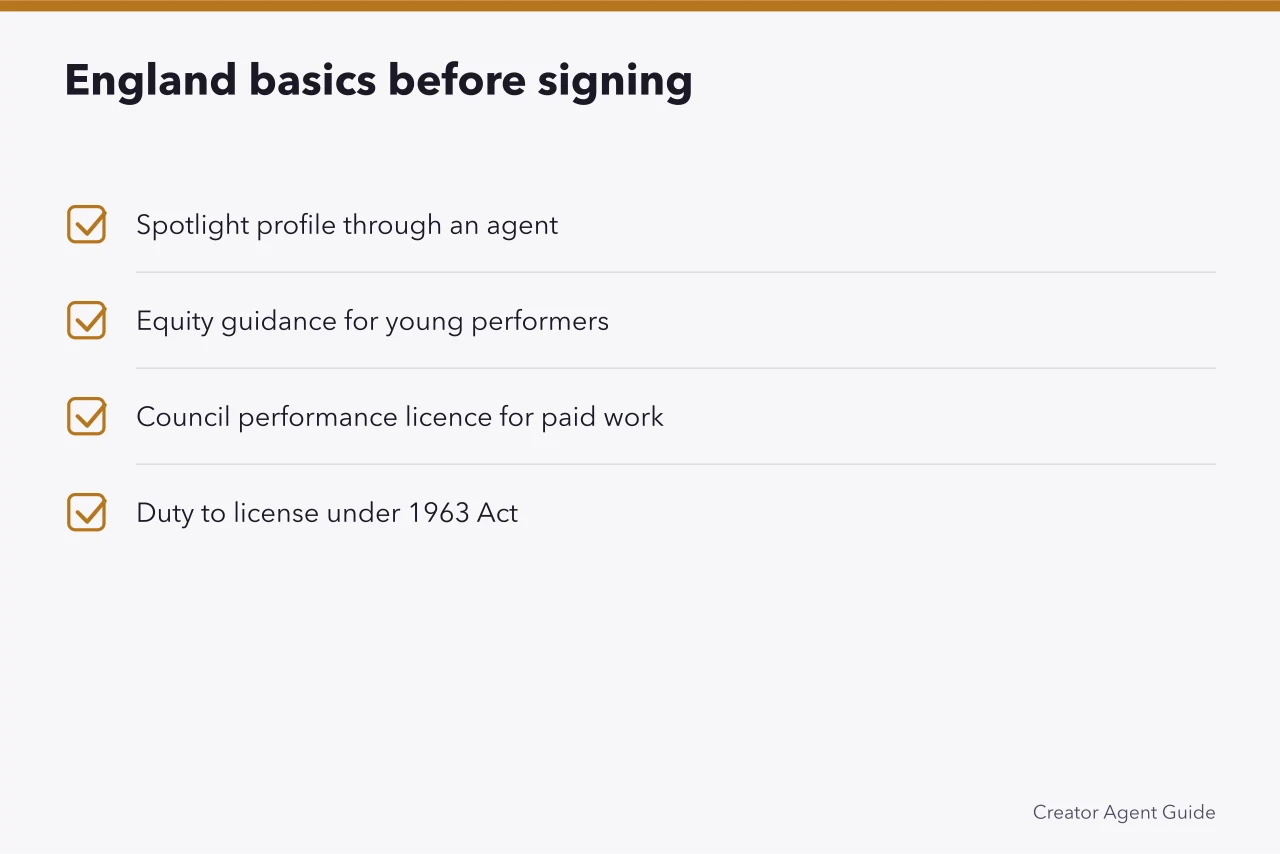
Equity, the performers' union, publishes guidance for young performers and their parents. Membership is optional, but it gives you somewhere to turn when a job goes wrong.
One England-specific step sits outside the agency. A child who performs for payment generally needs a performance licence from the council where they live, and the duty to license sits in the Children and Young Persons Act 1963.
How to check a children's agency
- Ask for the registered company name and number, then check it on the Companies House register.
- Ask how many children the agency represents, and how many auditions it submitted last month.
- Read the contract before signing. Our checklist of questions to ask a UK talent agency covers commission, notice periods and exclusivity.
- Ask what you are charged before work is found. The Employment Agencies Act 1973 governs how employment agencies may charge.
- Agree who pays for photographs, showreels and the Spotlight subscription.
- Confirm licence, chaperone and tutoring arrangements with your council before the first booking.
Hours, chaperones and school
Performance licensing is devolved, so Scotland, Wales and Northern Ireland apply their own rules. In England, regulations made under the 1963 Act set working hours, rest breaks and chaperone requirements for each booking.
Child employment guidance on GOV.UK explains the minimum ages for children who work and the permits councils issue for part-time jobs.
A long shoot can collide with school hours. Ask the agency who writes the absence letter and whether the production supplies tutoring.
What it costs and what to sign
Costs are predictable in shape, not in size. Commission is a percentage of the fee paid by the production. Photography, showreels and the Spotlight subscription sit outside that.
| Item | Who normally pays | What to check |
|---|---|---|
| Agency commission | Deducted from the production's fee | Whether VAT is added, and when it is invoiced |
| Spotlight profile | You, unless the agency covers it | Whether it is refunded if no auditions follow |
| Photographs and showreel | You | Whether the agency pushes one approved supplier |
| Licence and chaperone costs | Usually you | Which costs the production reimburses |
Ask about the notice period, the territory covered and whether the deal is exclusive. A contract that ties a child to one agency for years with no exit is a poor deal.
Payment terms matter as much as the fee. Ask when the production pays, who invoices, and how long the agency holds the money before passing it on.
If your child posts regularly, acting work and brand content blur. Our guide to UK child influencer rules covers advertising disclosure and platform age limits.
Common questions
Does my child need a licence to appear in an advert?
Usually yes, if it counts as a paid performance. Apply to the child performance team at the council where your child lives, and allow several weeks before filming.
Should I pay an agency a joining fee?
Reputable agencies earn commission from the work, not from your child. Ask what any upfront fee actually buys, and get the answer in writing before you sign.
Can my child take brand deals without an agent?
Yes. Plenty of parents handle small campaigns directly. Paid posts still have to be labelled as ads, and platforms set their own age limits for accounts.
How long does it take to start?
It depends on experience, location and how full the agency's books are. You will normally send photographs, a short showreel and any credits, then wait for an audition before anything is signed.