Rules and ethics
Part of UK child influencer regulations: what parents must know
UK child influencer regulations: what parents must know
What England's performance licensing, school absence rules and safeguarding duties mean for parents managing under-18 creators and brand deals.
What to take away
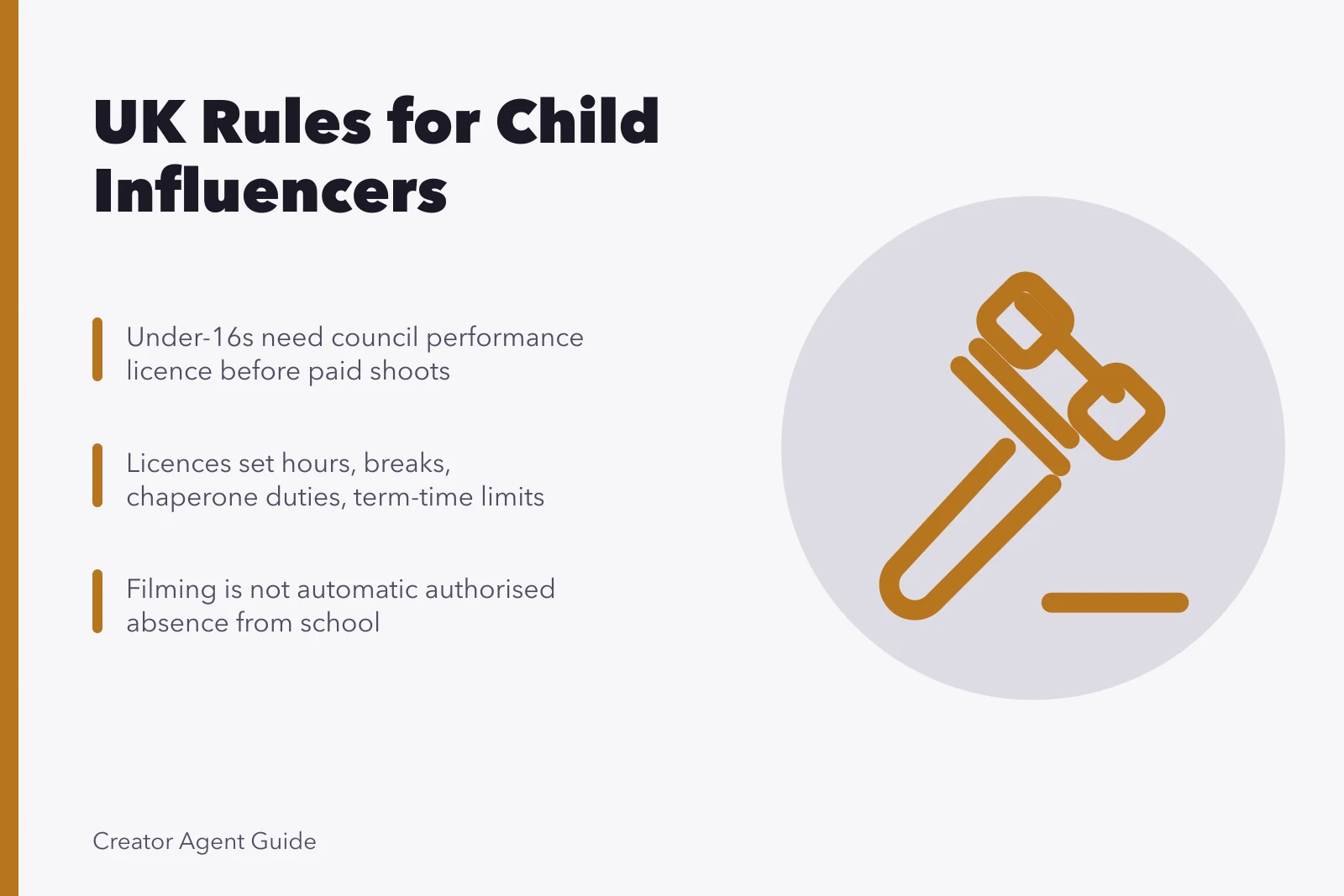
- In England, a child under 16 normally needs a council performance licence before a paid shoot, film, TV or modelling job.
- The licence sets hours, rest breaks, chaperone duties and term-time limits.
- Filming is not an automatic reason for authorised absence from school.
- Parents carry the safeguarding, data and contract decisions, not the brand.
- Agency commission, exclusivity and fee terms need checking before anything is signed.
Where the rules come from
Child influencer work is not covered by one rulebook. Licensing, employment, school attendance, advertising and data each have a separate source and a separate enforcer. The table below maps them.
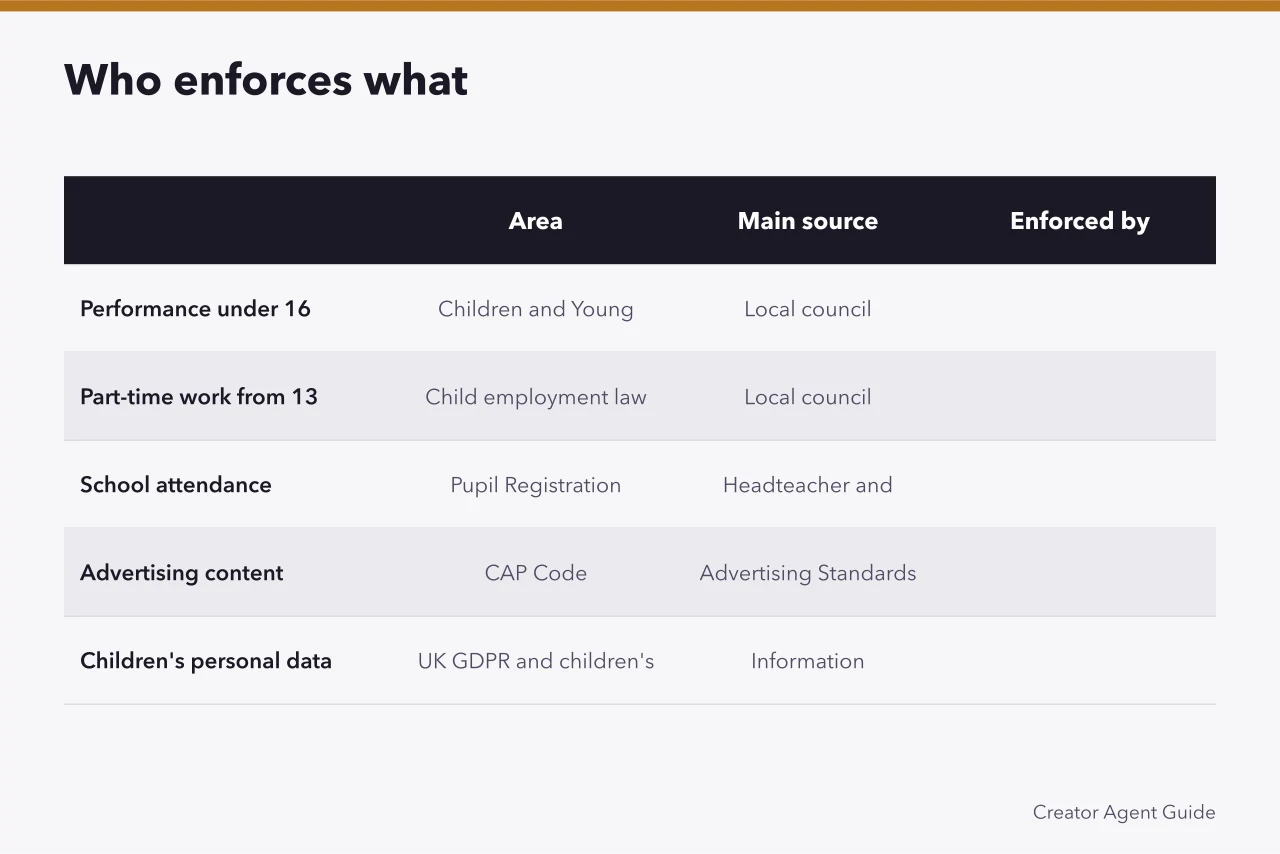
| Area | Main source | Enforced by |
|---|---|---|
| Performance and modelling, under 16 | Children and Young Persons Act 1963 | Local council licensing team |
| Part-time paid work from 13 | Child employment law and council byelaws | Local council |
| School attendance in England | Education (Pupil Registration) (England) Regulations 2006 | Headteacher, with council penalty notices |
| Advertising content | CAP Code | Advertising Standards Authority |
| Children's personal data | UK GDPR and the ICO's children's code | Information Commissioner's Office |
Performance licences in England
Section 37 of the Children and Young Persons Act 1963 makes it an offence to cause a child to perform without a licence where one is required. That covers council licensing for under-16s in paid films, television, theatre and modelling.
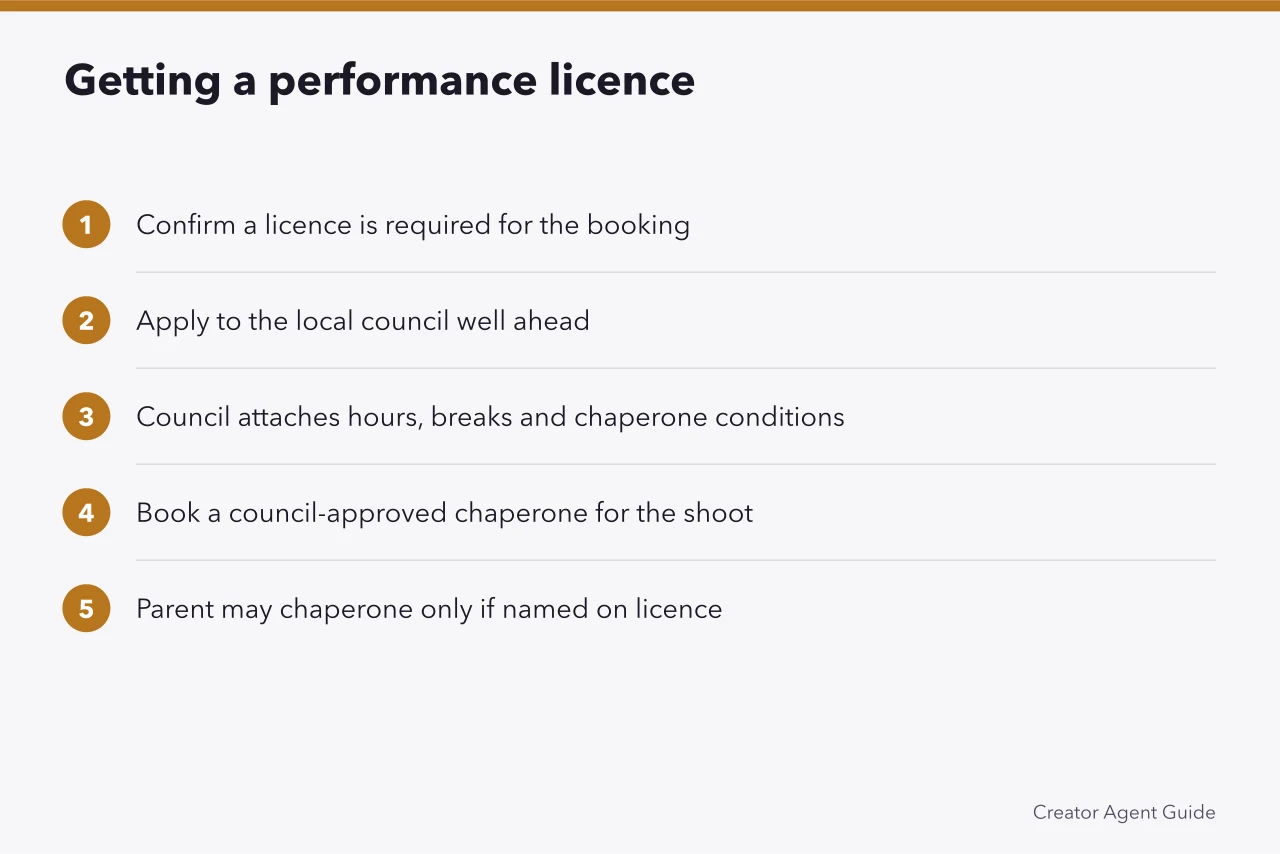
Councils attach conditions to each licence covering hours, breaks and chaperoning. Applications should go in well ahead of the first shoot day, so start the paperwork when a booking is confirmed.
A council-approved chaperone normally has to be present, and the person engaging the child cannot fill that role. A parent can sometimes chaperone if the licence names them.
Most children's commercial work reaches families through an agent. Our guide on how to find a children's talent agent in England explains how agencies placing under-18s are set up and what to check.
Minimum ages, hours and school
Child employment law sets the floor. GOV.UK's guidance on child employment says most children can work part-time from 13, with council byelaws setting hours, and that under-13s are only employed in areas such as television, theatre and modelling.
The licence carries the daily limits, rest breaks and any bar on working during school hours.
School attendance is separate. Headteachers in England can authorise absence only in exceptional circumstances, so a shoot does not qualify automatically. Unauthorised absence can lead to a council penalty notice.
Safeguarding, data and platform duties
Once a child has an audience, personal data is being processed. The ICO's guidance for organisations covers lawful bases, retention and the extra protection the children's code gives to under-18s online.
Safeguarding also covers who is around your child on set and who can access their accounts.
Platforms carry duties of their own. Ofcom's codes under the Online Safety Act 2023 require age checks and steps to keep children away from harmful content.
Advertising sits under the CAP Code, which has stricter rules for ads aimed at children and requires paid posts to be labelled clearly.
Checklist before your child signs
- Confirm with the council whether a performance licence is needed, and who is applying.
- Check the school's position on absence before accepting term-time dates.
- Read the contract for term, territory, content rights and exit routes.
- Ask what is charged: commission on earnings is normal, a work-finding fee is not.
- Agree where earnings are held, and what your child will and will not post.
Exclusivity deserves attention. If an agency ties your child to one representative for a fixed term, check what happens to enquiries from other brands. Our guide to talent agency exclusivity clauses covers the usual structures.
This is general guidance, not legal advice. A licensing dispute or a contract question needs a qualified adviser.
Common questions
Do child influencers need a performance licence for a brand video?
For a professional performance or modelling shoot in England, a licence is normally required for a child under 16. A child filming at home usually falls outside the rules, until a production company is involved.
Can a talent agency charge my child for finding work?
Agency conduct rules restrict work-finding fees for performers, so commission on earnings is the standard model. Ask what is charged, when, and whether anything is payable if no work is booked.
What are the school absence rules for filming in England?
Headteachers can authorise absence only in exceptional circumstances, so a shoot is not an automatic reason. Where absence is unauthorised, the council can issue a penalty notice.
Does data protection law apply to a child's channel?
Yes. UK GDPR applies wherever personal data is processed, and the ICO's children's code adds protection for under-18s online. Keep a lawful basis and a retention rule for fan messages.