Rules and ethics
Talent agencies creator payment terms: what UK managers actually invoice
How UK talent managers invoice brands, deduct commission, handle VAT and holdbacks, then pay creators a net share under the representation agreement.
What to take away
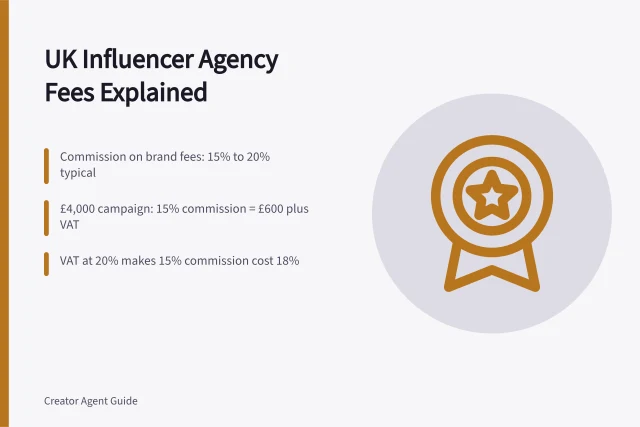
- Most UK talent managers invoice the brand or the brand agency, then pay the creator a net share under the representation agreement.
- Commission can be charged on gross or net campaign value, and the contract wording decides which figure applies.
- Deductions usually cover commission, VAT on that commission, agreed third party costs and a holdback against late payment.
- Payment terms of 30, 60 or 90 days push cash flow risk onto the creator, so the schedule matters as much as the rate.
- Write down who chases a late invoice, what interest applies and when holdbacks are released.
How money moves from brand to creator
A brand or its media agency books the campaign, signs a scope and issues a purchase order. The talent manager invoices against that scope. In most UK management deals the creator does not invoice the brand directly, which keeps the commercial relationship in one place.
Brand to creator payment flow
- Brand books campaign and signs scope
- Brand issues purchase order
- Talent manager invoices against scope
- Manager deducts commission and VAT
- Creator receives net share
Talent agents work inside a fee charging framework set by the Employment Agencies Act 1973. Commission, deductions and the payment schedule belong in the representation agreement, not in a verbal understanding.
VAT is the next checkpoint. If the manager is VAT registered, the commission invoice may carry VAT on top, even where the campaign fee sits outside the scope. Compare those terms with the Money and tax guidance on GOV.UK before signing.
Advertising rules apply to the content itself. Managers should confirm who handles disclosure on each campaign under the advertising codes.
What a UK management invoice usually deducts
| Invoice line | Raised by | Paid by |
|---|---|---|
| Campaign fee | Brand or brand agency | Brand |
| Management commission | Talent manager | Deducted from the creator share |
| VAT on commission | Talent manager | Creator, where applicable |
| Agreed third party costs | Manager or supplier | Creator |
| Holdback or reserve | Talent manager | Retained until the brand pays |
Commission deductions explained plainly: the manager takes an agreed percentage, and the remaining lines are either pass through costs or timing adjustments.
Who raises and pays each invoice line
Invoice line
- Campaign fee
- Brand or brand agency
- Management commission
- Talent manager
- VAT on commission
- Talent manager
- Agreed third party costs
- Manager or supplier
- Holdback or reserve
- Talent manager
Raised by
- Campaign fee
- Brand
- Management commission
- Deducted from creator share
- VAT on commission
- Creator, where applicable
- Agreed third party costs
- Creator
- Holdback or reserve
- Retained until brand pays
Paid by
- Campaign fee
- Management commission
- VAT on commission
- Agreed third party costs
- Holdback or reserve
Read the deduction clause and the payment schedule together. A generous rate on 90 day terms can pay less than a lower rate on 14 day terms.
Example: reading a management invoice line by line
Reading a management invoice line by line
- Check the contract rate and confirm whether it applies to gross or net.
- Match every cost line to a clause in the representation agreement.
- Confirm the invoice date, the brand payment terms and the due date.
- Track when the brand payment clears, because holdback release often depends on it.
- Pay the creator and issue a remittance statement showing gross, deductions and net.
If a cost line has no clause behind it, ask for it in writing before the creator accepts the net figure. That habit removes most disputes.
Payment schedules and late payment risk
UK talent agency payment schedules vary. Brands often push for 60 or 90 day terms while creators expect payment within weeks of delivery. That gap is the manager's working capital problem, but it becomes the creator's problem when holdbacks stay open.
Set a maximum holdback period, a release trigger and a written process for chasing debts. Where a contract is silent, UK commercial debt rules may still allow interest and recovery costs.
Child creators add another layer. Licensing rules for under-16 performers shape how and when money moves, so terms should name the licence holder and the account that receives payment.
Where AI changes invoicing and reporting
Time tracking, invoice matching and usage reporting are the repetitive tasks where software pays for itself fastest. The AI applications without the pilot trap page lists the numbers English agencies track before they scale spending on tools.
Tying payment terms to the wider plan
Payment terms do not stand alone. Commission rates, holdbacks and exclusivity clauses have to match the objectives, channels and compliance map the business runs on. A strategy framework in England should cover those choices before budget is committed.
Common questions
Who invoices the brand, the manager or the creator?
Usually the manager invoices the brand or the brand agency, then pays the creator a net share. Direct creator invoicing happens in some deals, but it splits the chase for late payment.
Should commission be charged on gross or net?
The contract wording decides. Gross commission takes a percentage of the full campaign fee, while net commission applies after agreed costs, and the difference can be material on larger campaigns.
What happens if the brand pays late?
The holdback and the payment schedule decide who carries the delay. Log the due date, chase in writing and pass through any late payment interest the contract allows.
Do child creators get paid differently?
Yes, in practice. Licensing and safeguarding rules shape how money moves, so terms should name the licence holder and the receiving account.